After eight years of work across Thiès, Pikine and Tivaouane in Senegal, Fort pour le Futur (FPF) has concluded, leaving behind long-lasting change including stronger youth networks, more accessible health and wellbeing services, and the establishment of formal mechanisms for young people to regularly engage with local municipalities to feed into city-level policy, something that previously did not exist.
A key part of this legacy is the transformation of existing volunteer peer educator networks into three youth-led associations, providing a stronger foundation for young people to continue their activities, mobilise resources and collaborate with local government beyond the project.
Supported by the Healthy Cities for Adolescents programme, FPF launched in Thiès in 2019 and expanded to Pikine and Tivaouane in 2022. The project focused on improving adolescent sexual and reproductive health and nutrition, while strengthening young people’s knowledge, leadership and participation in local decision-making.
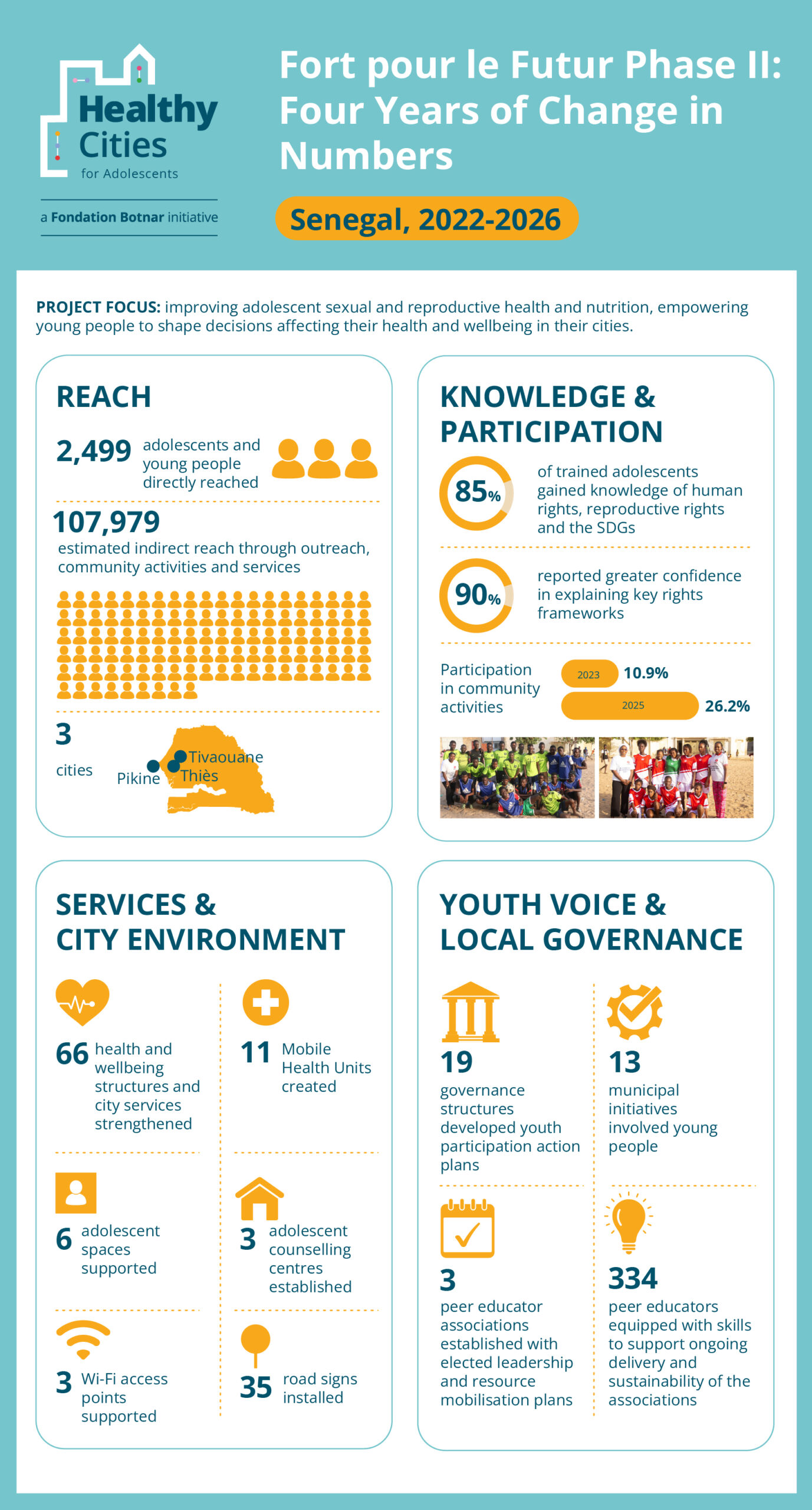
During Phase II, from 2023 to 2026, FPF directly reached 2,499 adolescents and young people (1,102 boys and 1,398 girls), with a further 107,979 estimated to have been reached indirectly through awareness campaigns, peer-to-peer outreach, Mobile Health Units, community mobilisation, digital TV and radio programming. The project’s final extension phase in 2026 focused on sustaining these achievements by strengthening three youth-led organisations and building more structured collaboration between peer educators, municipalities and public services.
Young people gained confidence and a stronger role in local decision-making
FPF supported young people to strengthen their knowledge of health, rights, citizenship and leadership, and provided opportunities to put these skills into practice through peer education, advocacy and community action.
More than 90% of surveyed young people reported greater confidence in explaining key rights frameworks. Between 2023 and 2025, the proportion of surveyed young people participating in community activities increased from 10.9% to 26.2%.
Beyond individual knowledge and confidence, the project helped create opportunities for adolescents to participate in local governance. Young people contributed to municipal planning, consultations and budget discussions, with some taking up roles in neighbourhood councils, city commissions and youth advisory structures.
Local institutions also began creating more formal opportunities for participation. Across the three target cities of Pikine, Thiès and Tivaouane, 19 governance structures developed action plans to support youth engagement, providing a basis for more regular dialogue between young people and decision makers.
Health information and services became more accessible
FPF combined targeted digital awareness campaigns, peer education and community outreach with improvements to adolescent health and wellbeing services. Across the three cities, more than 50 health and wellbeing structures and services were strengthened, including Mobile Health Units, adolescent-friendly spaces and counselling centres. These provided more accessible opportunities for young people to seek information, counselling and referrals, particularly on sensitive sexual and reproductive health issues where stigma could otherwise discourage them from seeking support.
Volunteer peer educators played an important role in this work. Already active within local health systems, they served as trusted messengers, helping adolescents discuss sensitive concerns, understand their options and connect with appropriate services.
The project also strengthened collaboration between peer educators and service providers, improving referral mechanisms and creating stronger links between community-based awareness activities and the health services available to young people.
Stronger youth-led organisations and local partnerships provide a foundation for lasting change
FPF’s final extension phase focused on a central challenge: how to ensure that youth participation, peer education and improved access to services could continue beyond project funding. One of its most significant achievements was supporting existing volunteer peer educator networks in Thiès, Pikine and Tivaouane to organise into three associations to be formally registered with elected leadership, statutes and internal regulations.
Previously operating as informal volunteer networks within the health system and the youth development sector, peer educators now have a more structured platform from which to organise activities, pursue partnerships and mobilise resources independently. Each association developed a resource mobilisation plan, supported by training in governance, financial management and advocacy. By project close, some members were already organising activities using membership contributions and support secured from other partners. The association in Tivaouane has already received official registration confirmation, while legal registration remains in progress for the associations in Pikine and Thiès.
As one association leader explained: “We can enter into partnerships with the town hall, apply for funding and organise our own activities without having to wait for a project.”
Alongside strengthening the associations themselves, FPF worked to embed their activities more firmly within local institutions. Municipalities began incorporating peer educators’ activities into local plans and programmes, while local authorities committed technical, logistical and financial support to help sustain their work. Young people contributed to 13 municipal initiatives, including youth advisory structures, health committees and budget discussions.
Peer educators also became more closely involved in district health coordination and consultation forums connecting health, education and youth services. These relationships strengthened referral mechanisms and created opportunities for more coordinated support for adolescents across sectors.
Together, these developments represent an important shift: peer educators are increasingly positioned not only as volunteers delivering project activities, but as organised youth actors able to initiate their own work and collaborate with local institutions.
Important challenges remain. Two associations still need to complete outstanding legal processes and secure reliable funding, while dedicated municipal budget allocations were awaiting confirmation at project close. Further efforts are also needed to strengthen young people’s influence in formal decision-making.
Nevertheless, FPF leaves practical foundations on which to build: young people with greater knowledge and confidence, more accessible and connected health services, youth-led organisations with growing independence, and stronger partnerships with local authorities. These achievements offer opportunities to sustain adolescent health, wellbeing and participation beyond the project’s eight years of work.