After 18 months of work in Indore, India, the ACT Indore: Adolescents for Climate Transformation project has concluded, leaving behind a new framework for youth participation in urban climate action, stronger community engagement and young people better equipped to influence decisions affecting their city.
Recognised as India’s cleanest city by the Clean India Mission, Indore is nevertheless vulnerable to climate change and related urban challenges and is taking action to address them. ACT Indore was built around a simple idea: young people experience these challenges in their daily lives but rarely have meaningful opportunities to influence how cities respond. The project set out to change this by giving adolescents the knowledge, practical tools and connections to identify problems, mobilise communities and work with local government on solutions.
Running from March 2025 to August 2026, the project identified and empowered young leaders to address local challenges related to heat, water and waste, culminating in the launch of the ACT Indore Framework to streamline adolescent participation youth participation in urban decision-making. Their work combined community research, storytelling and direct engagement with city authorities. Digital campaigns and community activities also reached wider audiences across Indore.
ACT Indore was delivered by a consortium led by Youth Ki Awaaz, with Start Up!, SHEDO and AAs Indore, in collaboration with the National Institute of Urban Affairs.
Young people are better equipped to lead climate action
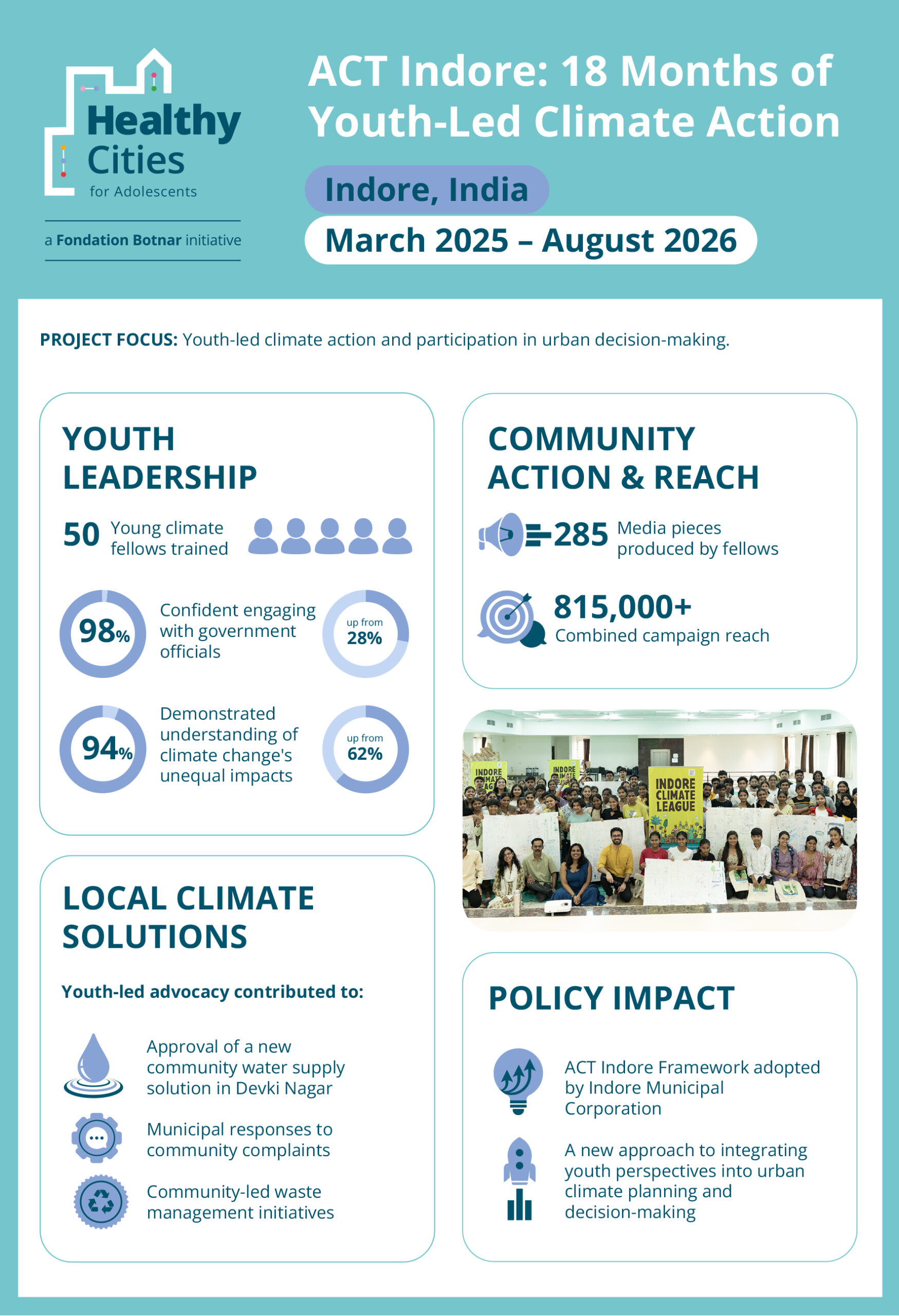
Through the ACT Indore Fellowship, 50 young people developed skills in climate awareness, community research, storytelling, campaigning and engagement with government institutions.
The change in their knowledge and confidence was significant. By the end of the fellowship, 94% of fellows demonstrated an understanding of how climate change affects different social groups, compared with 62% at the start. Meanwhile, 98% reported confidence in interacting with government officials, up from 28%.
Fellows put these skills into practice through household surveys, community meetings, neighbourhood walks and youth-led campaigns. Working in groups across different wards, they identified local challenges, collected evidence and developed solutions together with residents.
They also used storytelling to bring community experiences into public conversations. Across the project, fellows produced 285 media pieces, including digital stories, videos, documentaries and creative campaigns, contributing to a combined campaign reach of more than 815,000 people.
As one fellow explained: “We did transect walks in the community, talked to people, and gradually came to understand the root cause of a problem – how climate change is actually happening, and how we can approach it systematically with the authorities so that it isn’t just a temporary fix but an enduring solution.”
Youth-led campaigns helped communities address local problems
The fellows’ work went beyond raising awareness. Their campaigns helped communities bring specific problems to the attention of local authorities and, in several cases, contributed to practical responses.
In Devki Nagar, where residents faced unreliable water supplies and waste management problems, fellows surveyed households, organised community meetings and helped residents raise their concerns with elected representatives. With the support from the elected representatives, their work contributed to approval for the conversion of a disused borewell into a government-managed water source and a new pipeline.
Other groups helped residents report problems through municipal complaint systems, including a complaint that prompted a municipal cleanup visit. Fellows also developed a QR-code-based website to help community members submit complaints through the city’s existing grievance mechanism.
The project encouraged residents to take action themselves with the support of municipal officials. In some neighbourhoods, women’s groups began organising cleanups, promoting waste segregation and holding neighbours accountable for keeping shared spaces clean.
These changes demonstrated how youth-led action could bring communities and city institutions together around practical solutions.
Indore adopts a framework to involve young people in climate governance
One of ACT Indore’s most significant achievements was the adoption of the ACT Indore Framework by the Indore Municipal Corporation.
Developed through the project’s research, community engagement and consultations with city stakeholders, the framework provides an approach for bringing young people’s perspectives and locally generated evidence into urban climate planning and decision-making.
Its adoption marked an important step beyond individual campaigns, demonstrating that evidence collected by young people could inform how city institutions approach climate-related challenges.
The project’s experience also reached wider policy and research audiences. The ACT Indore Framework was presented at the XXI International Conference on Public Policy and Management in Bengaluru, where it was among 80 papers selected from 490 submissions.
the framework, there are encouraging signs of continued engagement at several levels. Some fellows remain active in their communities, while project partners are exploring opportunities for them to become peer mentors and community champions, supporting other young people to take action.
Community ownership is also emerging. In Devki Nagar and Narwal, women’s groups have committed to continue organising cleanups and promoting waste segregation independently, demonstrating how activities initiated by young people can encourage lasting changes in local practices.
At the institutional level, Youth Ki Awaaz and Devi Ahilya Vishwavidyalaya (an Indore university) are in early discussions about opportunities to build on the framework and fellowship model. Project partners are also exploring joint fundraising and ways to integrate climate action into their ongoing work.
While the long-term sustainability of these initiatives will depend on continued institutional support and resources, the legacy of ACT Indore is more than a trained group of young people: it’s an adopted framework, emerging community-led practices and partnerships that could support continued youth participation in Indore’s climate governance.